Keys to Accelerating Your Coding Skills
The Key To Accelerating Your Coding Skills
Keys to Accelerating Your Coding Skills
Article from: http://blog.thefirehoseproject.com/posts/learn-to-code-and-be-self-reliant/
The Key To Accelerating Your Coding Skills The Key To Accelerating Your Coding Skills
When you learn to code, there is a moment when everything begins to change. At Firehose, we like to call this the inflection point of coding. After this phase, the way you operate as a developer will be dramatically different. Building up to the inflection point is the process of becoming self-sufficient in programming, to the point where you no longer need any hand-holding. It can be a frustrating experience, but once it’s behind you, it is incredibly empowering.
When you learn to code, there comes a point when everything starts to change. In Firehose we like to call this the inflection point of coding. After this stage, the way you operate as a developer will be very different. Building to an inflection point is the process of achieving self-sufficiency in programming until no more manual work is required. This can be a frustrating experience, but once it’s behind you, it’s incredibly empowering.
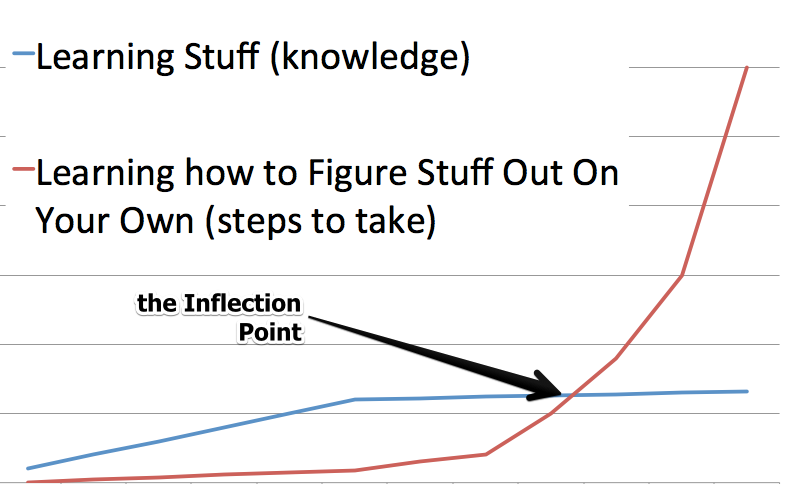
At Firehose, our goal isn’t just to teach you Ruby, how to build web applications, or how to write tests. Although we do teach these skills and more, our primary goal is to accelerate students past the inflection point so they gain the ability to solve any problem they encounter. We believe that being able to problem solve on your own is an invaluable skill, and this method of teaching will take you much further than simply learning how to build a set of apps. In Firehose, our goal is not just to teach you Ruby, how to build web applications, or how to write tests. While we teach these skills and more, our primary goal is to accelerate students through the inflection point so that they can solve any problem that comes their way. We believe that being able to solve problems yourself is an incredibly valuable skill, and this teaching approach will take you much further than simply learning how to build a set of applications.
The Tutorial Phase (3-8 weeks of serious coding) Tutorial Phase (3-8 weeks of serious coding)
When you start out learning to code, there’s a lot of information that you don’t know yet. This information is called domain-specific knowledge. Examples include: knowing how to write a loop in ruby or how to extract something from a database using Ruby on Rails. Domain-specific knowledge encompasses the protocols unique to a certain programming environment. When you start learning to code, there’s a lot of information you don’t know yet. This information is called domain-specific knowledge. Examples include: Learn how to write loops in Ruby, or how to pull content from a database using Ruby on Rails. Domain-specific knowledge consists of protocols unique to a particular programming environment.
The first step to becoming a self-sufficient developer is learning how to do specific tasks. Once you master certain tasks, the broad strokes of how the pieces fit together will start to become apparent. Over time, you’ll begin to recognize patterns and eventually, the things that initially seemed confusing and foreign will become second nature. The first step to becoming a self-sufficient developer is learning how to complete a specific task. Once you master a task, you’ll discover how the pieces fit together. Over time, you’ll start to recognize patterns, and eventually, what initially seemed confusing and unfamiliar will become second nature.
For students starting out, the most important skill to acquire is attention to detail.
Paying close attention to detail is important when going through materials like documentation or tutorials. Even the most minor typos and misspellings will result in error messages or bugs. Seeing error messages is a frustrating experience at first, but it’s a crucial step in the learning process. Dealing with error messages and problems in this phase teaches you one of the most important skills of programming within a safe environment: being detail-oriented. When browsing materials such as documentation or tutorials, it’s important to pay close attention to details. Even the smallest typos and misspellings can lead to error messages or errors. Seeing error messages is a frustrating experience initially, but it’s a critical step in the learning process. Dealing with error messages and problems during this phase will teach you one of the most important skills for programming in a secure environment: being detail-oriented.
Debugging error messages is incredibly important. The fact of the matter is, error messages are just a part of programming: they are seen by inexperienced and very experienced developers alike. The only difference is, the more experience you have dealing with error messages, the less time you’ll need to spend trying to fix them. Here’s why: Debugging error messages is very important. In fact, error messages are just part of programming: inexperienced developers and very experienced developers alike see error messages. The only difference is that the more experience you have dealing with error messages, the less time you will spend fixing them. The reasons are as follows:
-
Over time, you will learn how to read error messages and extract the relevant details of the problem quickly. The first time you see an error message, it will take you a while to decode what it actually means. But after you’ve seen hundreds of error messages (and you will see hundreds!), you will be able to pinpoint the problem’s location and the relevant details you need in order to fix it. Over time, you’ll learn how to quickly read error messages and extract relevant details about the problem. When you first see an error message, you need to take some time to understand what it actually means. However, after you see hundreds of error messages (and you will see hundreds!), you will be able to pinpoint the location of the problem and the relevant details needed to fix it.* You should learn from each error message that you resolve. Don’t just fix the error and be done with it; understand what is wrong with the code you’re fixing. By learning from each of your errors, the next time you make the same mistake, you’ll be able to fix it much faster. You should learn from every error message you resolve. Don’t just fix the bug and deal with it; understand what’s wrong with the code you’re fixing. By learning from your mistakes, you will be able to correct them faster the next time you make the same mistake.
-
Initially, you will probably ask for help on each error message you see. Over time, you’ll learn to ask for help less frequently by double-checking your code and conducting smart Google searches. Initially, you may ask for help with each error message you see. Over time, you’ll learn to ask for help less often by double-checking your code and doing smart Google searches.
In the tutorial phase, you will follow instruction. At first, you’ll find it challenging to follow instructions and error messages will happen frequently. Over time, you’ll develop the skill to debug errors and pay better attention to small details, and you’ll be able to make progress much quicker. As you’re wrapping up the tutorial phase, you’ll notice you’re able to write code at a much more rapid pace. During the tutorial phase, you will follow the instructions. At first, you will find it challenging to follow the instructions and error messages will occur frequently. Over time, you’ll develop skills in debugging errors and get better at paying attention to small details, and you’ll be able to make progress faster. By the end of the tutorial phase, you will notice that you are able to write code much faster.
At this point, some people feel confident– like they’re ready to ditch the training wheels and start building things without structured guidance– and will happily dive into the deep end. Other students will reach for more tutorials, trying to obtain more domain-specific knowledge in search of a “full understanding.” Unfortunately, tutorials will only take you so far, and true confidence isn’t found in tutorials or guides. True confidence comes from struggling through a problem you have no idea how to solve, and discovering a solution on your own. At this point, some people will feel confident - like they’re ready to ditch the training wheels and start building something without structured guidance - and will happily jump into the deep end. Other students will seek out more tutorials in an attempt to gain more domain-specific knowledge in search of “complete understanding.” Unfortunately, tutorials will only take you so far, and true confidence is not found in a tutorial or guide. True confidence comes from struggling with a problem you don’t know how to solve, and discovering your own solution.
**The dirty little secret of programming is…**The dirty little secret of programming is…
You will never know everything you need to know to solve all your problems. Going into the journey, you probably envisioned yourself eventually learning everything you need to learn, and then being squared away. This moment will never happen. You can never know everything you need to know to solve all your problems. In the process, you might imagine yourself finally learning all you need to learn and then being set free. This moment will never happen.
Programming is a life-long learning experience. Experienced software engineers seek to find solutions to problems they haven’t solved yet because it gives them the opportunity to learn more. If you find yourself waiting for the moment when you finally feel like you know everything there is to know about coding, know this: the day you’re waiting for will never come. And that is a wonderful thing. Programming is a lifelong learning experience. Experienced software engineers seek solutions to problems they haven’t solved yet because it gives them the opportunity to learn more. If you find yourself waiting for the moment when you finally feel like you know everything there is to know about coding, know this: the day you’re waiting for never comes. This is a great thing.
**You will be ready to jump into the next phase of your journey when:**You will be ready to jump into the next phase of your journey when:
-
You’ve seen enough error messages that they no longer startle you. Instead, you know how to decipher what they mean and where to look for the problems in your code. You’ve seen enough error messages that they don’t scare you anymore. Instead, you know how to decipher their meaning and where to look for problems in your code.
-
You’re a pro at Googling for solutions. When you’re working to add a feature or see a confusing error message, you know what to search for to find the information you need. You are an expert in searching for solutions. When you’re adding a feature or see a confusing error message, you know what to search for to find the information you need.
-
You’re able to reference code you’ve written in other parts of your application and follow patterns within them, rather than always seeking out step-by-step instructions. Instead of always looking for step-by-step instructions, you can refer to code you’ve written in other parts of your application and follow the patterns.
The Inflection Point (2-4 weeks with the right mentality)The Inflection Point (2-4 weeks with the right mentality)
The inflection point stage is one of the most frustrating stages of learning to code, but in many ways, it’s the only stage that matters. It’s the point when you phase out of using tutorials and begin solving problems for which no one has lined up a solution for you. The inflection point stage is one of the most frustrating stages of learning to code, but in many ways, it’s the only stage that matters. That’s the point when you gradually abandon using tutorials and start solving problems for which no one has a solution for you.At some points, you will feel like you aren’t ready to tackle this phase and like you want to return to building something with an outline of exactly what to do. Don’t fall prey to this mentality. The reason you’ll feel frustrated is: At some point, you’ll feel like you’re not ready to handle this phase and want to reframe it in a clear way. Don’t fall victim to this mentality. Reasons you may feel frustrated are:
During the inflection phase, you will be coding 10-20 times SLOWER than in the previous phase.
During the inflection point stage, your encoding will be 10-20 times slower than the previous stage.
You may start questioning yourself and wondering if you are actually capable of becoming a programmer. Feelings of insecurity and doubt are common in this stage. You may start to question yourself and whether you are really capable of being a programmer. Feelings of insecurity and doubt are common during this stage.
Despite the fact that you’ll feel like you’re learning and accomplishing things at a much slower rate, in reality, you are achieving the things that matter the most. While your domain-specific knowledge is screeching to a putter, everything you’re learning will be about procedural knowledge. Even though it may feel like you’re learning and completing things much more slowly, in reality, you’re getting the most important things done. While your domain-specific knowledge will be difficult for putting, everything you learn will be related to procedural knowledge.
Procedural knowledge is the ability to teach yourself what you don’t know along the way. When you need to implement a new feature, what type of Google search should you do? At this point in time, you’ll feel like you’re “in the dark” when it comes to many of the things you want to accomplish. Learning how to find the light on your own is critical because you can never know everything there is to know, so you need to be able to teach yourself how to solve the problem at hand. Procedural knowledge is the ability to teach yourself something you don’t know. What type of Google search should you perform when you need to implement a new feature? At this time, when you want to accomplish a lot, you can feel like you’re “in the dark”. Learning how to find the light yourself is crucial because you can never know everything, so you need to be able to teach yourself how to solve the problem at hand.
Most people do not realize that in order to learn to code, you need to learn both domain-specific and procedural knowledge. Most people do not realize that in order to learn to code, you need to learn both domain-specific and procedural knowledge.**
For the rest of your life, go outside your limits every single day For the rest of your life, go outside your limits every single day
Some software engineers stay inside their comfort zone once they find their footing. These types of programmers are known as maintenance programmers– not something you should strive to be. Instead, you should strive to go outside your limits every single day. The most common reason programmers quit their jobs is because “it’s not challenging anymore since I’ve solved all the interesting problems.” Some software engineers stay in their comfort zone once they find their footing. These types of programmers are called maintenance programmers - it’s not something you should strive to be. Instead, you should strive to push your limits every day. The most common reason programmers quit their jobs is: “Now that I’ve solved all the interesting problems, it’s no longer challenging.”
Rather than trying to pull coding projects into your comfort zone, you should be seeking out problems that are outside your current skill set. This is the only way to build on and expand your skills. Rather than trying to push coding projects into your comfort zone, you should identify problems outside of your existing skills.
In the words of a Firehose student upon passing his inflection point:
I still feel like I’m in the deep end! I’m just getting more comfortable knowing that’s where I’ve got to be! I still feel like I’m in the abyss! I feel so much more comfortable knowing where I’m going!
In web development, there are actually two inflection points that will come together. In web development, there are actually two inflection points.
The web development inflection point is the point when you become capable of building any database-driven application that you want. This means being able to build a web application with many pages that stores and retrieves information from a simple database. Web developers call this: “mastering CRUD.” At this phase, you should also be able to integrate with any 3rd party library (a ruby gem for example) simply by following the documentation provided on GitHub or a blog post. The web development inflection point is the inflection point where you are able to build any database driven application you want. This means being able to build a web application with many pages that can store and retrieve information from a simple database. Web developers call this: “Mastering CRUD”. At this stage, you should also be able to integrate with any third-party libraries such as ruby gems by following the documentation or blog posts available on GitHub.
The algorithm and data structures inflection point is a less superficial inflection point, but it is actually more important. Someone who has conquered this point will have mastered the programming language they’re working in, in addition to mastering the fundamentals of programming and having a depth of knowledge for solving complex coding challenges. Algorithms and Data Structures Inflection is a less superficial inflection point, but it’s actually more important. People who overcome this will have mastery of the programming language they are using, in addition to mastering the basics of programming and in-depth knowledge of solving complex coding challenges.People who have conquered the algorithm and data structures inflection point will be able to: People who overcome the inflection point in algorithms and data structures can:
- Write sorting algorithms Write sorting algorithms
- Implement and reverse linked lists Implementation and reverse linked lists
- Understand and write programs leveraging stacks, queues, and trees Understand and write programs leveraging stacks, queues, and trees
- Write computer programs using recursive or iterative solutions Write computer programs using recursive or iterative solutions
In short, once you pass this inflection point, you will have mastered data manipulation and will understand the performance implications of your code decisions. Traditional computer science degrees focus exclusively on getting students past the algorithm and data structures inflection point. Many universities teach this with programming languages that are generally not used in the industry, like Scheme, Racket, or LISP. In short, once you pass this inflection point, you have mastered data manipulation and will understand the performance impact of your coding decisions. Traditional computer science degrees focus on getting students past the inflection point of algorithms and data structures. Many universities teach this course in programming languages that are not typically used in industry, such as Scheme, Racket, or LISP.
In most technical interviews, the interviewer will assume you’ve passed the web development inflection point, given that’s easier to do, and focus their questions on evaluating your skill in algorithms and data structures. These questions will generally focus on the topics we mentioned above: sorting algorithms, reversing linked lists, and using stacks, queues, and trees. *In most technical interviews, the interviewer will assume that you have passed the breaking point in web development because that is easier to do, and they will focus the questions on assessing your skills in algorithms and data structures. These questions usually focus on the topics we mentioned above: sorting algorithms, reverse linked lists, and using stacks, queues, and trees.
Once a developer has passed both the web development inflection point and the algorithm and data structures inflection point, they hold the keys to the kingdom.
These developers will be able to solve challenges that intersect the two: complex algorithms that need to be built in the context of advanced web applications. This is at the heart of what professional web developers do every single day. These developers will be able to solve challenges in both areas: complex algorithms that need to be built in the context of advanced web applications. This is the core of what professional web developers do every day.
Consequences of the Inflection Point Consequences of the Inflection Point
The biggest consequence of the inflection point will sound a bit counterintuitive when you first hear it. Take a deep breath in: When you first hear about inflection point, its biggest consequence may sound a little counterintuitive. Take a deep breath:
When learning to code, domain-specific knowledge doesn’t matter in the grand scheme of things. When learning to code, domain-specific knowledge doesn’t matter in the grand scheme of things.**
Yup. I’m not joking– it really doesn’t matter that much at all. Once you pass the inflection point, these concepts will fluidly translate with just a week or two of tutorials, maybe even days! Yes. I’m not kidding - it’s really not a big deal. Once you pass the inflection point, the concepts will translate smoothly in a week or two of tutorials, maybe even a few days!
What ultimately really matters is: What really matters is:
- You have a solid grasp on a web development framework You have a solid grasp on a web development framework
- You have a solid grasp on writing algorithmically complex code in any programming language
Hiring managers want developers with solid web development and algorithm skills. Hiring managers want developers with solid web development and algorithm skills.
While I was working at PayPal, my team hired a Senior Rails Developer who had no experience in Rails– he had been coding a lot in Python, LISP, and Perl. Within a couple of days, he was already making a big impact. And within weeks: a huge impact. He quickly rose to become the technical team lead and was one of the best hiring decisions I’ve ever been involved in. When I worked at PayPal, my team hired a senior Rails developer with no Rails experience - he wrote a lot of code in Python, LISP, and Perl. Within days, he was already making a huge impact. Within a few weeks: a huge impact. His rapid promotion to technical team leader was one of the best hiring decisions I have ever been a part of.
Don’t sweat the stack. Many people will say things like, “AngularJS is hot these days,” “JavaScript is on the rise,” or “the latest fad is…” My response to that is: “so?” When you’re learning how to program, your singular goal should be to find the inflection point and annihilate it. Once you do, learning that new, sexy fad won’t be a difficult task at all. Don’t sweat the stack. Many people will say, “AngularJS is hot recently”, “JavaScript is on the rise”, or “the latest fad is…” When you learn how to program, your only goal should be to find the inflection point and eliminate it. Once you do this, learning new, sexy fashion won’t be a difficult task.Become self-reliant. Having the ability to learn new coding skills without structured guidance means you no longer need to wait for anyone to help you out. This means that for the majority of what you need to learn, you can simply search the internet and read the various material on what you need to know. *Become self-reliant. *The ability to learn new coding skills without structured guidance means you no longer have to wait for anyone’s help. This means that for most of what you need to learn, you can simply search the Internet and read various materials on what you need to know.
This doesn’t mean you immediately “know” everything, but just that everything is now “figure-out-able,” so in essence, you are unstoppable. This doesn’t mean that you “know” everything right away, but that everything is “solvable” now, so in essence, you are unstoppable.
The Skills You Will Develop During the Inflection Point
As a software developer, the best reference material is similar code that you have already written. When you fully understand the code you’ve written, you don’t need to commit all the details to memory. This means that *the first question you should ask yourself when building a new feature is: “Have I built something similar before?” now?" As a software developer, the best reference material is similar code you’ve already written. When you fully understand the code you’re writing, you don’t need to commit all the details into memory. This means that when building a new feature, the first question you should ask yourself is: “Have I built something similar before?” If the answer is yes, then take a fresh look at the code and mentally walk through the code line by line. Re-explain to yourself what it’s doing and ask yourself: “Can I use the same method now?”
Videos suck at explaining domain-specific details because they take so darned long to watch. Say you want to integrate with the Google Maps API. Once you’ve experienced doing so once, it can take less than a minute to open the code up in GitHub, copy the code, and paste it into a new project. Videos, on the other hand, can often take 10-30 minutes to re-watch. Videos are terrible at explaining specific areas of detail because they take a long time to watch. Let’s say you want to integrate with Google Maps API. Once you have this experience, it takes less than a minute to open the code in GitHub, copy it, and paste it into a new project. Video replay, on the other hand, usually takes 10-30 minutes.
Strategies for Passing the Inflection Point as Efficiently as Possible Strategies for Passing the Inflection Point as Efficiently as Possible
Because passing the inflection point is the most important part of learning to code, you should set yourself up to make the process as smooth as possible. This means you should start preparing while you’re in the tutorial phase and maintain the right mindset during this period of time. Because passing the inflection point is the most important part of the process of learning to code, you should make your process as smooth as possible. This means you should start preparing during the tutorial phase and stay in the right mindset during this time.
*During the tutorial phase, take breaks from going over structured material and give yourself challenge problems along the way.
-
For every handful of lessons, try to do something that is outside the scope of the tutorial you’re following. If the tutorials you’re going through provide “challenges” or “self-directed” pieces, do all of them. Solving unguided challenges will give you the important experience of doing things without structured guidance. If the tutorial you’re following offers a “challenge” or “self-guided” section, then do it all. Solving non-directive challenges will give you important experience doing things without structured guidance.
-
Try to use tutorials as little as possible. At Firehose, we often walk students through how to integrate certain gems or do things using the provided documentation. Rather than simply following the instructions explained in tutorials that are geared towards people who are just starting out, many students will follow the documentation and use the tutorials as a back-up. Note that documentation will treat you like a developer who has passed the inflection point. Getting comfortable reading and following documentation on GitHub will give you a leg up when you’re on your own. Use tutorials as little as possible. In Firehose, we often instruct students on how to integrate certain gems or do something using the provided documentation. Instead of simply following the instructions in a tutorial for those just starting out, many students will follow the documentation and use the tutorial as a backup. *Please note that the documentation will treat you as a developer who has passed the inflection point. * Easily reading and following relevant documentation on GitHub will give you an advantage when going independent.
-
Focus on the essentials and use repetition. Learn how to do common things like spinning-up an application from scratch, pushing a new app to GitHub and Heroku, and building a database migration early on. Learn how to do common things like building an app from scratch, pushing new apps to GitHub and Heroku, and building database migrations early.
Pushing through the inflection point can be challenging. Here are some pointers to get you through it: Pushing through the inflection point can be challenging. Here are some tips to help you get through it:* Understand that this is a difficult process and go easy on yourself. Also, set realistic expectations. You can’t compare your “superman”-level speed of going through tutorials to your “snail”-speed of learning things on your own. Keep in mind that you’re learning plenty, but at this phase, you’re learning a brand new skill of figuring new things out on your own. Also, set realistic expectations. You cannot compare your “superhuman” level learning speed with your “snail” level self-learning speed. Remember, you’ve learned a lot, but at this stage you’re learning a whole new skill set and discovering new things on your own.
- If you’re struggling with self-confidence, know that what you’re feeling is completely normal. Keep working. If you continue to struggle, try talking to someone who has recently passed the inflection point. They will be able to relate to the position you’re in and will assure you that what you’re experiencing is only temporary. will only prolong the time you spend building up to the inflection point. If you are struggling with your self-confidence, know that what you are feeling is completely normal. Keep working. If you’re still struggling, try talking to someone who’s just past their turning point. They will be able to relate to the position you are in and reassure you that what you are experiencing is only temporary. Keep working, but don’t overwork. At this stage of the game, you need to know that you can only work a maximum of 6 hours a day. Working from a state of exhaustion will only prolong the time it takes for you to build up to the breaking point.
The best way to gain confidence at this stage is to power through any doubts you have. Your emotions may start to feel like a roller coaster. At times, you’ll feel like you’re on fire, but after 15 hours of struggling on the same problem, it’s very common to feel the polar opposite. The best way to gain confidence at this stage is to overcome your doubts. You may be on an emotional roller coaster. Sometimes you feel like you’re on fire, but after struggling with the same problem for 15 hours, you usually feel like the opposite.
It can be frustrating to have no idea if something will take you 5 minutes or 5 hours, but every time you power through and successfully implement a new feature, the rush of confidence will be everything you need. After solving a handful of hard problems without any help, you’ll be addicted to the feeling of building things outside your comfort zone. It can be frustrating if you don’t know if something is going to take you 5 minutes or 5 hours, but every time you work hard and successfully implement a new feature, that rush of confidence will be all you need. After solving some tough problems without any help, you’ll become addicted to the feeling of building something outside your comfort zone.
How to know when you’ve passed the inflection point
The final stage of the inflection point process is acceptance. Acceptance that software development is a process of continuous learning. Acceptance that the feeling that you’ve successfully learned everything just means you should start thinking about solving more complicated problems. The final stage of the inflection point process is the acceptance stage. Accept that software development is a continuous learning process. Accepting the feeling that you’ve successfully learned everything means you should start thinking about solving more complex problems.
Have you experienced the inflection point yet? Share this post and start a conversation with your friends– you would be surprised how many people have reached and surpassed this moment. Have you ever experienced an inflection point? Share this post with your friends to start a conversation – you’ll be surprised how many people have reached and exceeded this moment
What do you mean there are TWO inflection points? Isn’t an inflection point where everything starts to make sense? If one part in the development starts to make sense, why then do you call it an inflection point? Is there no way to unify these “inflection points” into something more concrete? What do you mean there are two inflection points? Isn’t there a turning point where everything starts to make sense? If a certain part of the development starts to make sense, then why call it an inflection point? Isn’t there a way to unify these “inflection points” into something more concrete?
Great question! Basically there are two keys to being a solid web developer: Great question! There are basically two keys to becoming a reliable web developer:
- Building a Database Driven application. Developers call this “building crud apps”. This will push data into a database, maybe integrate with a few gems, etc. Once you code enough web apps you’ll notice there is a pattern/formula that will get you through 90% of the stuff you build. *Build a database driven application. Developers call this “building crud applications”. Once you write enough web applications, you’ll notice that there’s a pattern/formula that helps you get 90% of the work done building it.
- Solving algorithms is a bit different. Basically instead of following a pattern, it usually involves a lot of trial-and-error before things work as you expect.
- *The solving algorithm is a bit different. Basically, unlike following a pattern, it usually requires a lot of trial and error before things work as you expect.
The two eventually intersect when building complex apps in the real world. The two eventually intersect when building complex applications in the real world.For example if you’re building a chess game, storing game information, user login, all standard stuff that is involved in building a CRUD app. But, there are more complicated algorithms you’ll need to also support. Think: determining if a user is in check, or checkmate. Or if a move is valid. For example, if you are building a chess game, store game information, user logins, and all the standard stuff involved in building a CRUD application. However, you also need to support more complex algorithms. Consider: Determining whether the user is checked or not. Or if an action is valid.
Solving algorithms don’t help you build a form and prompt the user for stuff. Prompting the user and storing things in a database doesn’t help you with algorithmically challenging things. When you are solid at the patterns you’ll use to do 90% of the time, and the algorithms that you need the 10% you can solve most challenges you’re faced. Solving algorithms doesn’t help you build forms and prompt users for input. Prompting the user and storing the data in a database doesn’t help you solve algorithmic challenges. When you’ve mastered the patterns you’ll use 90% of the time, you need the algorithms you need to solve most of the challenges you face.
I never seem to get past the domain specific and procedural knowledge stage. Why? I never seem to get past the Domain Specific Knowledge and Procedural Knowledge stages. Why?
Getting past the domain specific and procedural stage is a bit hard. First you need to be comfortable reading and understanding things like documentation and things that are intended for “intermediate” programmers rather than “beginners”. Once you can read and use the documentation you’ll have a good way to teach yourself new topics. Getting through specific areas and process stages is a bit difficult. First, you need to be able to easily read and understand content such as documentation that is geared toward “intermediate” programmers rather than “beginners.” Once you can read and use these documents, you have a great way to teach yourself a new topic.
Then you need to be willing to go outside your comfort-zone and be ok spending time working through things on your own. Find a problem that excites you and go for it! Then you need to be willing to step out of your comfort zone and take the time to solve the problem on your own. Find a problem that excites you and do it!
Keep coding, Chris! 🙂
I really don’t know what to say about this article or this one “How You’ll Know You’re Ready to Start Working as a Web Developer” I really don’t know what to say about this article or this “How do you know you’re ready to start working as a web developer” It went straight to my brain as if while reading I was watching my self in a mirror. It went straight into my brain and it was like I was looking at myself in the mirror while reading. What an excellent and brilliant article. You can probably call this Psychology for developers. What a wonderful article. You could call this mentality a developer. I still feel weird after reading this (in a good manner). why? After reading this I still feel weird. Why? I am currently a biochemist with some years in the field. Yes I do DNA ,RNA molecular biology, is fun and everything but… it does not pay well.( currently bellow and close to 40 000) I am currently a biochemist and have been working in the field for several years. Yes, I do DNA and RNA molecular biology, which is very interesting, but… the salary is not high. (currently about 40,000 people) This year I decided to completely change my carrier from that to a developer which I really love. In 11-12 month ( I actually started seriously in jan-feb 2015) I started from 0, (zero, nada) and learned HTML, css ,JS , some jQuery, some C#, some android. Now I know how to make a website( responsive of course) and I am developing my own ASP.Net MVC web app. This year I decided to completely change my vector and become a developer that I actually enjoy. In 11-12 months (actually I started seriously in January-February 2015), I learned HTML, css, JS, jQuery, c#, android from scratch. Now that I know how to make a website (responsive of course), I’m developing my own ASP. Net MVC web application.
Some of You will say a year and still not in the field? well I have 3 children and …40 years old. Some have told me I am late to this. but still I think I can make it but it is hard (but still I dont fill safe and actually if were to apply for a job I will feel like an impostor) Some of you would say a year and you haven’t started working yet? I have three kids…40 years old. Some people told me I was late. But I still think I can do it, but it’s hard (but I’m still not qualified, in fact I’d feel like a fraud if I applied for a job)
This article really describe some of the points where I feel now or the sensation that I am not ready when probably I already am Thanks for this
This article really describes some of the feelings I’m feeling right now, or maybe I’m ready, but I’m not ready yet thanks
You’re probably more ready than you think, Ernest! Keep up the awesome work on your coding journey! Go outside your comfort-zone! You may be more prepared than you think, Ernest! Keep up the good work on your coding journey! Get out of your comfort zone!
What to read next
Want more posts about Translation?
Posts in the same category are usually the best next step for reading more on this topic.
View same categoryWant to keep following #Translation?
Tags are useful for related tools, specific problems, and similar troubleshooting notes.
View same tagWant to explore another direction?
If you are not sure what to read next, return to the homepage and start from categories, topics, or latest updates.
Back home